Jamtable Jamtable AI omnichannel commerce platform
Syd
Jamtable · AI commerce platform

One platform for your store and everything behind it.

Storefront, point of sale, catalogue, inventory, purchasing, warehouse, fulfilment, delivery, finance, documents, marketing and AI sit on a single catalogue, a single stock position and a single customer record.

See the twelve capabilities
One platform · six things you would otherwise buy separately
22 modules 12 production databases 298 screens 1 production tenant
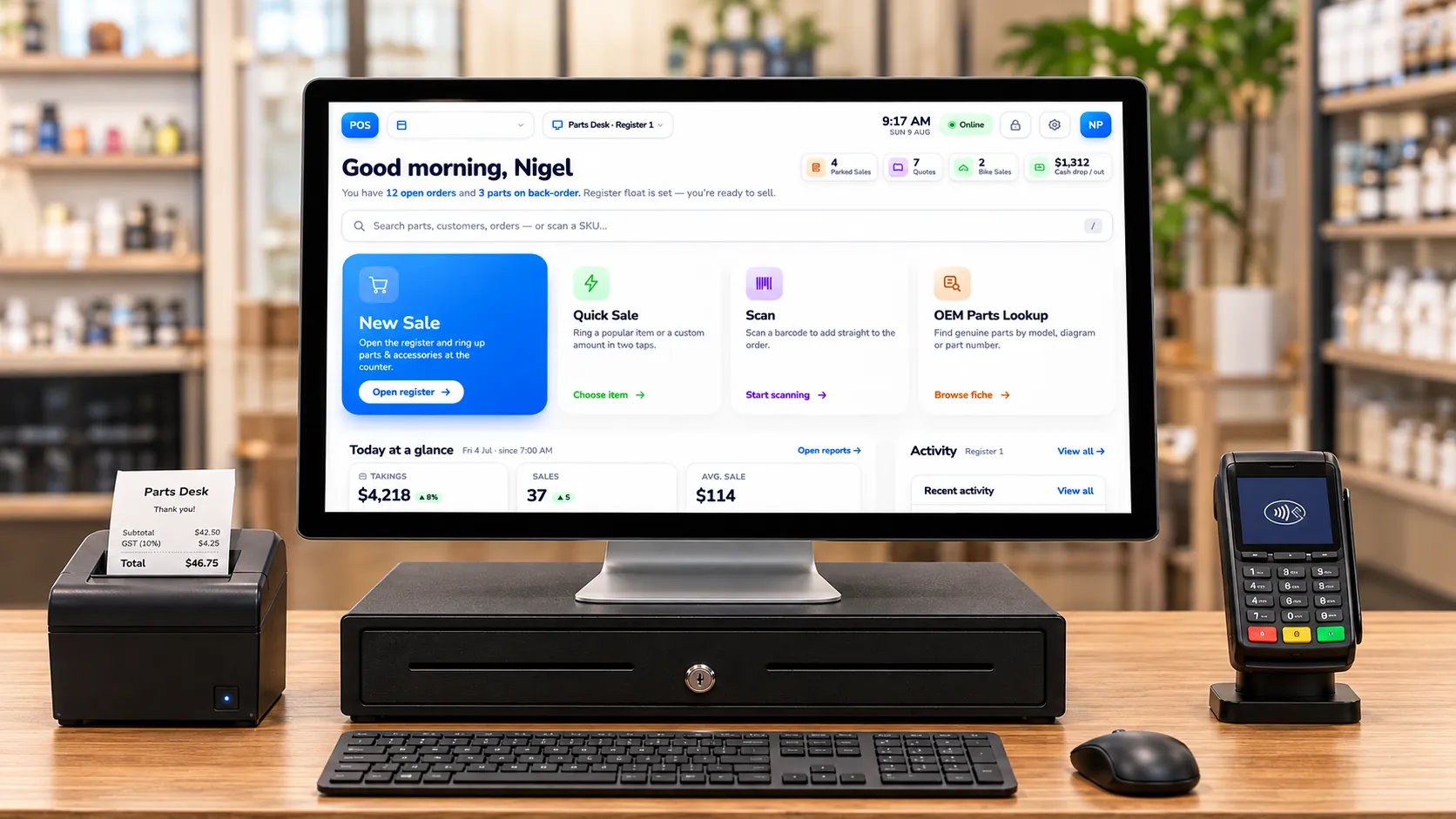
A Jamtable point-of-sale terminal on a retail counter, with receipt printer, cash drawer and card terminal.
Hawkesbury Motorcycles · Founding tenant The counter reads the same catalogue and the same stock position as the storefront. There is nothing to reconcile at the end of the day beyond the cash drawer.
The argument

Anyone running an online store ends up with a stack.

A storefront platform, a point of sale, something for stock, a folder of supplier spreadsheets, an app for email, and an accounting package downstream of all of it. Every one of those choices is defensible on its own. Together they produce a business that cannot answer a simple question, such as what a given item has actually cost by the time it reaches a customer, or how much stock is genuinely available to sell right now.

Jamtable was built the other way around. One data model, twelve production databases behind a single API, and every surface reading from the same source. Composable where it needs to be, through a module matrix that lets each business run only the parts it uses. Opinionated where it matters, so money, stock and documents follow a controlled sequence with separation of duties enforced by the platform rather than by staff discipline.

It runs at the edge on Cloudflare, multi-tenant from the first line of code, with AI in the foundations rather than bolted to the side. It was proven first in one of the hardest categories in retail — a motorcycle dealership, where stock is serialised, compliance-bound, financed, traded in and frequently sold before it physically arrives. A platform that holds up under that will not struggle with a catalogue of apparel.

The audience

Who it is for

Any business with an online store and something real behind it. Stock to count, orders to pick, suppliers to buy from, customers to keep, and money to reconcile.

The value scales with operational complexity. A single online store with one stockroom gets a fast storefront, a clean catalogue and one place to work orders. A business running a shop floor, a warehouse, a purchasing function and a service department gets the whole argument, because those are the parts that normally sit in separate systems and disagree with each other.

Modules are switched on per business. Nobody pays for a workshop they do not have, and nobody is shown a screen they will never open.

One write · every module current

One event. The whole platform already knows.

Nothing in here syncs. There is no nightly export and no connector waiting to catch up. An event lands once on the shared core, and every module that depends on it is current from that same write — which is the entire argument for running the stack as one platform.

Core capabilities

Twelve capabilities, on one set of data.

Each one owns something the others rely on. They behave as one system rather than as a suite, because they read from the same catalogue, the same stock position and the same customer record.

  1. 01 · FoundationUnified commerce core
  2. 02 · Online StoreStorefront and e-commerce
  3. 03 · Point of SalePoint of sale
  4. 04 · Online StoreOrder management
  5. 05 · Warehouse ManagementInventory and stock control
  6. 06 · Warehouse ManagementPurchasing and suppliers
  7. 07 · Warehouse ManagementWarehouse and fulfilment
  8. 08 · Delivery PlatformDelivery
  9. 09 · Digital Marketing PlatformCustomers and loyalty
  10. 10 · Digital Marketing PlatformMarketing and communications
  11. 11 · ECHO AIECHO AI
  12. 12 · Dealership ManagementVertical depth
01 · Unified commerce coreFoundation

One catalogue. One stock position. Every channel.

Every channel reads from the same catalogue and the same stock position, in real time. Sell an item in store and the web listing decrements before the customer has their receipt. Reserve something online and it cannot be sold twice.

This is the foundation the rest of the platform sits on.

  • A single catalogue shared by every channel and every location
  • Live availability by location, stockroom and bin, with allocated, on-order and available held separately
  • One customer record, identical at the counter, in the back office and on the storefront
  • One order spine, so a web order, a counter sale and a staff-entered order are the same kind of object
  • Configuration held in the backend, so a rule changed once applies everywhere
  • Twelve purpose-built databases behind one API, so no module is slowed by another module's schema
  • Modules switched on per business, so the platform fits the operation rather than the other way round
02 · Storefront and e-commerceOnline Store

Your website is a view of your business, not a copy of it.

The storefront is generated from the same catalogue, stock and pricing everything else uses, and edited from the same admin. Pages, blocks, media, navigation, theme and SEO all live in the CMS, and per-page SEO completeness scoring tells you which pages are still missing a description before Google does.

Built on Astro at the edge, so pages are fast by construction rather than fast after an optimisation project.

  • Live catalogue with real stock, and complete purchase online, end to end
  • Page builder with reusable content blocks, templates, drafts, publishing states and archive
  • Media library with a shared asset store, and theme, navigation and brand controlled per business
  • Hero sliders, promotional banners and campaign placements scheduled from the marketing calendar
  • Site-wide SEO with per-page completeness scoring across title, description, OG image and canonical
  • Click and collect from any location, and refundable holding deposits where a purchase needs one
  • Google and marketplace feed synchronisation
  • Multi-location storefront with per-location content and opening hours
  • Core Web Vitals treated as a build constraint, not a report
03 · Point of sale

The counter, at counter speed.

The point of sale runs on whatever hardware is already there: iPad, touchscreen, laptop or phone. It is keyboard driven for staff who know what they are doing, and it holds the full catalogue, live stock across every location, and the customer's complete history in the same screen as the transaction.

Because it is not a separate application talking to a commerce API, there is nothing to reconcile at the end of the day beyond the cash drawer.

  • Full-catalogue terminal with live cross-location stock lookup
  • Customer lookup at the counter, with order and purchase history attached
  • Co-purchase suggestions on add to cart, mined from actual order history rather than manual rules
  • Cash drawer open, count and reconcile, with configurable float, variance tolerance and full drawer history
  • Card and integrated payment handling, and split payment across methods
  • Receipt printing, and digital receipts delivered by SMS as a secure download link
  • Terminal-level security policy, staff sign-in, and per-terminal configuration
  • Configurable order status labels, so the language on screen matches the language on the floor
The Jamtable point of sale on a desktop monitor, showing today's takings, quick actions and recent activity. The Jamtable point of sale on an iPad, showing the helmet category and an order with two lines and a silver-tier discount. The Jamtable point of sale on an iPhone, showing takings, a new sale button and the manage grid.
The same terminal on a desktop, an iPad and a phone. Same catalogue, same stock, same customer record — no separate till software to buy, install or reconcile.
04 · Order managementOnline Store

One queue, every channel, one set of rules.

Web orders, counter sales and staff-entered orders land in one order spine with one status model. The queue is worked rather than watched: priority is calculated, exceptions are quarantined for review rather than silently failing, and every status change carries an audit entry.

  • Unified order queue across web, counter and phone
  • Order creation wizard for staff-entered and phone orders
  • Priority calculator, so the queue reflects promised dates and pick economics rather than arrival order
  • Quarantine for orders that fail validation, held for a human rather than dropped
  • Separate order streams where a product type genuinely needs a different workflow
  • Discount management with mandatory reason codes, plus discount analytics so margin leakage is visible
  • Order analytics covering value, mix, conversion and cycle time
  • Full audit history on every order and every status transition
05 · Inventory and stock controlWarehouse Management

Know what you have, where it is, and whether it should be there at all.

Stock is tracked by location, stockroom and bin, with allocated and on-order held separately from available, so the number on screen is the number you can actually sell. Range status classifies the catalogue for buying and reordering, allocation rules decide who gets scarce stock, and stock takes run as a planned workflow rather than a weekend.

  • Live stock positions by location, stockroom, room type and bin
  • Range status classification — core range, ranged, non-ranged, obsolete — with a rules engine to maintain it
  • Reorder thresholds and low-stock alerting per stocked line
  • Stock allocation rules, so committed stock is honoured
  • Inventory adjustments with an approval step and a full activity log
  • Serialised stock tracking with barcode generation and label printing
  • Stock takes: planning, creation, execution, variance review and settings
  • Missing SKU detection, so gaps in the catalogue surface before a customer finds them
  • Product information management across the whole catalogue
06 · Purchasing and suppliersWarehouse Management

From reorder point to receipted invoice, in one thread.

Purchase orders are raised from demand rather than from memory. A single register collects everything flagged for reorder across the business, including items other parts of the business are waiting on, and consolidation rules combine them into the smallest sensible number of orders. Supplier catalogues and price files are ingested, cleaned and standardised on the way in.

  • Purchase order creation, tracking, consolidation and consolidation rules
  • A single register collecting every flagged line across the business
  • Purchasing automation, so routine reorders raise themselves against defined rules
  • Supplier directory, onboarding workflow and per-supplier profile management
  • Supplier catalogue and price file ingestion with scheduled import runs and run history
  • Automated supplier image download into owned storage, so product imagery is not hotlinked
  • Discrepancy handling for short, over and damaged receipts
  • Supplier invoices, carrier settings and update process reporting
07 · Warehouse and fulfilmentWarehouse Management

Routing decided by economics, not by whichever location is closest.

Every line is routed against live stock in milliseconds: which location picks it, who picks it, and how it ships. Pick cost, stock health and promise date all feed the decision, so the system does not empty a profitable location to save a courier leg.

  • Goods receipt against purchase orders, with expected deliveries visible ahead of arrival
  • Zone, aisle and bin location structure, with bulk generation for new sites
  • Pick list generation and picking workflow, sequenced by bin rather than by order
  • Put-away planning from accepted deliveries, so received stock has a bin before it lands
  • Serialisation for true lifecycle cost tracking, down to a single unit
  • Inter-location transfer requests and transit tracking
  • ABC classification, so counting and slotting effort follows value
  • Cycle count scheduling as an ongoing discipline rather than an annual event
  • Consignment tracking for stock held but not owned
  • Ship from store, and pick and pack from any location holding stock
08 · DeliveryDelivery PlatformLocality Management

Real-time ETAs, quoted from your business logic and your capacity.

Delivery is priced and promised by rule rather than by phone call. Postcode zones, product category, condition, value and what the dispatch bench can actually get out the door drive both the cost and the window, and the live estimator lets staff and customers see the same answer, because it runs the same rules.

Rules a customer can see, and a business can defend.

  • Postcode-based delivery zones with per-zone pricing and cut-off times
  • Category-specific delivery rules, so bulky or regulated items follow their own logic
  • Delivery timeframe editor with per-zone estimated windows
  • Surcharge management for remote, oversized and specialist carriage
  • Route optimisation across the day's drops, sequenced by promise time and load
  • Real-time ETAs recalculated against live dispatch capacity, not a fixed table
  • Delivery milestones, so the customer is told where their order is
  • Live estimator for staff and storefront, running the same rules
  • Your own drivers on the roster, each with a vehicle, a working day and a load limit
  • Runs built for the day, drops sequenced and assigned to a driver
  • Capacity per run and per day, so the window a customer is quoted is one you can keep
  • Advanced configuration for carrier selection, exceptions and overrides
Fulfilment channels One rule set decides which channel quotes a given order — by zone, category and weight.
  • In production
    Own delivery trucks

    Drivers, runs and capacity are yours to set. Routing, ETAs and proof of delivery run inside the platform, on the same order record.

  • Commissioning
    Australia Post

    Rated parcels, labels and tracking numbers written back to the order, so milestones reach the customer the same way as a truck run.

  • Per tenant
    Couriers and freight

    Specialist carriage for oversized, regulated or interstate items, quoted by the same zone and surcharge rules rather than by phone.

09 · Customers, enquiries and loyaltyDigital Marketing Platform

One customer record, and every conversation attached to it.

Enquiries, live chat, tickets and campaign responses all resolve to the same customer, and the record carries orders, purchase history, saved items and loyalty position. Ticket rules route and prioritise automatically, so nothing sits in a shared inbox waiting for somebody to notice it.

  • Customer directory, profiles, creation and search, with activity across every channel
  • Communications hub covering enquiries, tickets and live chat in one queue
  • Ticket rules for automatic routing, assignment and escalation
  • Live chat with storefront visitors, connected to the same customer record
  • Enquiry analytics and configurable enquiry policy
  • Loyalty programme with tiers, points earn and redeem, expiry, and a customer-facing portal
  • Loyalty analytics covering tier distribution, at-risk members and points liability
  • Saved items and watch lists, giving a direct demand signal on what is not currently in stock
  • Customer tiers driving tiered pricing
10 · Marketing and communicationsDigital Marketing Platform

Every outbound surface in one place, using the customer record you already have.

Campaigns, segments, email, SMS, promotions, pricing rules, reviews and short links, all built on live customer and order data rather than an exported list. A segment is a query against the actual business, so a campaign to customers who have not bought in six months is a segment, not a spreadsheet.

  • Multi-channel campaign planning across email, SMS and loyalty
  • Customer segments built from live order and loyalty data
  • Email marketing with campaigns, lists, automations, sender identities, domain authentication, suppression and deliverability reporting
  • Transactional email templates and inbound webhook event handling
  • SMS via Twilio, with campaigns, transactional templates, digital receipts, and STOP handling under Australian spam regulations
  • Pricing promotions and a promotional calendar, aware of state public holidays
  • Discount reason codes, so every discount is attributable
  • Google Business Profile management and review response templates
  • Recommendations manager, controlling the co-purchase and related product engine
  • Short link management with click analytics, and wishlist shares as demand signals
  • Marketing analytics across campaigns, channels and revenue attribution
11 · ECHO AI

An assistant that can answer, because it is inside the data.

ECHO is not a chat window over a knowledge base. It has direct, permissioned access to the platform's own data through a large library of configured skills, so it answers operational questions with real numbers and returns work you can act on. Ask it for slow-moving stock by location and it produces a reorder position, not a paragraph about inventory management.

Two assistants, deliberately separated. The internal assistant has full operational access for staff. The customer-facing assistant sits on the storefront with a much narrower surface and no access to operational data.

  • Natural-language operational queries across customers, orders, inventory, finance and performance
  • A large configured skill library giving direct, permissioned access to platform data
  • Retrieval over your own documents, policies and knowledge base, with a managed source list
  • Declines rather than guesses when a question falls outside its knowledge
  • Multi-model routing, so a better or cheaper model can be substituted without a rebuild
  • Cost and usage dashboards, per-model performance, and a full request log
  • Configurable agent settings, guardrails, memory and brand voice
  • Separate internal and public assistants with separate permissions and separate logs
  • MCP surface, so ECHO connects into Claude, ChatGPT or an existing stack
  • AI document classification applied to incoming files
12 · Vertical depthDealership Management

Proof that the model holds under load.

Most commerce platforms treat a product as a line with a quantity. That works until the thing being sold is individually identified, legally regulated, financed, traded in, or sold before it physically exists. Jamtable models all of that natively, because the founding business sells motorcycles and none of it was optional.

This matters even if you never sell a vehicle. A platform that carries serial numbers, compliance documents, finance applications, trade-ins and a controlled sale-to-release sequence is not going to be defeated by a catalogue of apparel.

Switch it off if you do not need it.

This entire capability is a module. A business selling apparel never sees a compliance form.

  • Serialised asset register covering new, used, demo and consigned stock across the full lifecycle
  • Separate intake paths per source, each capturing what that path actually needs
  • Registration, VIN and chassis lookup against Australian vehicle data, with results cached
  • Spec taxonomy and attribute management with deduplication tooling, so filtering stays clean at scale
  • Compliance document generation and management
  • A controlled sale state machine from quote to release: deal builder, parked sales, deposits, contract generation and digital signing
  • Finance quoting, pre-approval routing, application tracking and an embeddable repayment calculator
  • Trade-in valuation requests
  • Booking and trial workflows with terms capture, licence capture and configurable policy
  • Competitor pricing comparison against live market listings
  • A release gate, so nothing leaves before funds and paperwork clear
ECHO
ECHO AI

Ask the platform a question. Get work back.

Every other assistant sits outside the data and guesses. ECHO is inside it — permissioned, skilled, and looking at the same rows the counter is looking at. Ask it something you would otherwise ask three people and wait a day for.

A real exchange
Asked at the counter

“Which stocked lines have not sold in ninety days, and what is the money tied up in them?”

ECHO

Forty-one lines, $18,340 at cost. Thirty of them sit in one stockroom. Nine are already flagged obsolete by the range rules, so they should not have been reordered — the automation raised them anyway because no threshold is set. Here is the list, the reorder positions, and the three suppliers to stop buying from first.

Read inventory_positions range_status purchase_orders

Sources are the honesty rail. ECHO lists what it actually read. If it read nothing, it says so and declines rather than guessing.

What it does that a chat window cannot
  • Answers with your numbersDirect, permissioned access to customers, orders, inventory, finance and performance through a large configured skill library.
  • Returns work, not proseAsk for slow-moving stock by location and it produces a reorder position you can act on.
  • Two assistants, separated on purposeFull operational access for staff. A much narrower surface on the storefront, with no access to operational data and its own log.
  • Hundreds of models, frontier to freePick the model per assistant, per task or per tenant — the top frontier models where the answer has to be right, free and open-weight ones where volume matters. Cost ceilings, per-model performance and a full request log come with it, so switching is a setting rather than a rebuild.
  • MCP, in both directionsECHO exposes an MCP surface, so Claude, ChatGPT, Copilot or an agent you build can query the same permissioned data — and consumes MCP servers of yours, so your own tools become skills it can call.
  • Conversations that end in a purchaseOn the storefront a question becomes a basket. ECHO reads live stock and fitment, narrows to what actually suits the customer, builds the cart and hands the checkout back — and when it cannot close, it drops a qualified enquiry with the transcript attached rather than an abandoned chat.
Configured, not prompted Every assistant is set up in the admin surface rather than by pasting a prompt somewhere. Ten controls, all versioned and all per tenant.
BehavioursRules for what the assistant may do, refuse, escalate or hand to a human — enforced server-side, not requested politely.
Brand voiceTone, vocabulary, spelling and the things you never say, so the storefront assistant sounds like the business and not like a model.
Temperature and limitsCreativity, response length, token and spend ceilings set per assistant. Tight and literal at the counter, warmer on the storefront.
Skills and document loadingTurn individual skills on or off, and load documents — price lists, policies, supplier manuals — that the assistant reads before it answers.
Company KB articlesYour own knowledge base, written once and cited by both assistants. Fix an answer in the article and every future answer changes with it.
AutoRAG retrievalUploaded material is indexed and re-indexed automatically, so retrieval stays current without anyone maintaining a vector store.
Model routingWhich model answers, per assistant, and what it falls back to when a provider is slow or down. Changed in the admin surface, not in code.
Data scopeThe tables and records an assistant may read, scoped by role. A storefront assistant cannot see cost, margin or another customer.
Answer loggingEvery answer kept with its sources, tokens and cost, per tenant, so a wrong answer can be traced to what it read.
Draft and previewRun real questions against a draft configuration before it goes live, and compare the two answers side by side.
Two minutes · ECHO answering live against the founding tenant
Demo video slot. Drop the recording in here and it plays inline — no lightbox, no autoplay.
Also in the platform

Ten more capabilities, several module-gated.

Real capabilities, written shorter because they support the argument rather than carry it. Open any one.

13 Service and repair For any business that fixes what it sells.

Job cards, staff, bays and parts all live in the same system as the sale that created the work. A technician sees their own jobs and can pick up unassigned ones. Parts on order for a job are visible to purchasing without anybody sending a list.

  • Floor view and bay board, showing every item on site and its state
  • My Jobs, showing a technician their assigned work and the unassigned pool
  • Service requests, check-in and checkout workflow
  • Diary and scheduling against real capacity and skill
  • Service invoicing, drawn from labour and parts consumed on the job
  • Full service history by customer and by item
  • Parts demand from open jobs feeding straight into purchasing
14 Finance Money owed, money held, and money owed to you by your suppliers.

The operational money that falls between a commerce platform and an accounting package: receivables, on-account balances, deposits, refunds, supplier rebates and reconciliation. It is not a general ledger and does not try to be.

  • Receivables and on-account balance tracking
  • Payment reconciliation against orders
  • Refund request workflow with approval
  • Accounts payable and cash flow forecasting
  • Supplier rebate programmes, rebate claims and rebate file import
  • Separation of duties enforced by the platform: sales staff never record payments
  • Funds verification gate before high-value goods are released
15 Documents and compliance Generated, signed, stored, retained and provable.

Documents are produced from platform data rather than typed, then held under a retention policy with an audit trail against every access.

  • Template builder and reusable document templates
  • Guided document wizard and direct document creation
  • Certified document issue and verification
  • File conversion into managed documents, and document merge
  • AI document classification on ingest
  • Document types, categories and approval workflows
  • Retention and disposal policies, and a full document audit trail
17 Analytics and reporting Reporting on the operational data, not on an export of it.

One analytics hub across the whole business, reading the same rows the operational screens read.

  • Order, product and pricing comparison analytics
  • Allocation rule analytics and purchase order metrics
  • Goods receipt analytics and supplier performance
  • Customer tier analytics
  • Google Analytics integration alongside first-party data
  • Search, keyword and ranking analytics
  • System health and test status dashboard
18 Identity and access Multi-tenant, multi-domain, and validated before your code runs.

Tenant context is resolved automatically per domain, and a token is validated at the edge before application code executes.

  • Complete isolation between tenants
  • Google Workspace, Microsoft Entra, Apple ID and email one-time-code sign-in, selectable per tenant
  • JWT sessions with PBKDF2 key derivation at 100,000 iterations
  • Role-based access control down to the individual action, with page-level permissions
  • White-label capable
19 Security, privacy and data protection Built to the Australian Privacy Principles, and auditable against them.

Customer contact details are masked by default, revealed deliberately, and every reveal is logged against the person who made it.

  • AES-256-GCM envelope encryption on identity and licence fields, and on personal data in object storage
  • Customer data access log, reviewable
  • Password-protected and one-time-code protected exports
  • Rate limiting on unauthenticated endpoints and signed webhook verification
  • Runtime input validation on all request data, and a per-tenant CORS allowlist
  • Privacy request handling for access and erasure
  • OWASP scan status and findings surfaced in the admin
20 Platform management Rules, weights and thresholds live in config, not in code.

Navigation, notifications, receipts, calculators and module policy are all configured rather than deployed.

  • Employee records, registration and staff account management
  • Staff messaging and internal team chat
  • Notification centre, notification settings and popup notifications
  • Business, locality and system settings
  • Menu management and menu design, so navigation is configured rather than deployed
  • Digital receipt, repayment calculator and finance application settings
  • Short link and tag management
21 Multi-tenancy and operations One installation, many businesses, operated as a product.

Reserved for the platform operator rather than the tenant. It is what makes the module matrix, provisioning and entitlements a product surface instead of a deployment task.

  • Tenant provisioning and tenant configuration
  • Module matrix and platform feature entitlements, controlling what each tenant sees
  • Platform dashboard, monitor and health
  • Cron job management, queue detail and background processing visibility
  • Object storage management and controlled data clearing
  • Retrieval data sync and sync profiles behind the AI layer
  • Integration management and the outbound API surface
22 Migration and onboarding Getting off the old system without losing the audit trail.

The migration module exists because the founding tenant had twenty years of legacy data. It is a working reconciliation surface, not a one-off script.

  • Migration overview covering datasets, load statistics and reconciliation state
  • Stock reconciliation, identifying items owned but not visible to a customer
  • Parts reconciliation against the legacy catalogue
  • Load history, so it is clear what was last loaded and when
Honesty register

What is live, what is commissioning, what is not built.

Feature copy that overstates is the fastest way to lose a deal at reference-check stage, and the fastest way to lose a customer in month two. So here is the register, as at 7 August 2026.

Carrying real load

The founding tenant trades on the platform today.

  • Storefront and content
  • Order management
  • Delivery rules
  • Customers and enquiries
  • Documents, deposits and contracts
  • ECHO AI
  • Serialised stock

Built, commissioning

Available, but do not treat them as proof points yet.

  • Point of sale — terminal, drawer, payments and security all built, no counter history yet
  • Parts and accessories — 5,989 lines loaded, 174 carrying a stock position
  • Workshop — full workflow built, no completed job history yet
  • Loyalty — 22 members enrolled, zero points earned or redeemed
  • SMS — integration live, low volume, delivery reporting not yet meaningful
  • Range status rules engine — built, currently switched off
  • Reorder thresholds — logic exists, no thresholds set, so alerting is inactive

Not built

Planned. Not available in any form.

  • Marketplace — reserved in navigation only
  • Parts, accessories and fitment search — phase two
  • Image compression — images stored at original size and quality
  • Gear and accessories on the storefront — marked as coming
One caveat worth holding onto.

Every claim on this page is proven at exactly one business, in one category. The platform is multi-tenant, provisioning is built and the module matrix works, but a second tenant in a different category has not yet run on it.

Next step

Book a discovery call.

One hour. Your actual problem. We will tell you which parts of this you would actually use, and which platform you should buy instead if it is not this one.

Book a discovery call

A paragraph is plenty. One email. No sequences. With a time, or a straight no.

Jamtable
Jamtable
AI omnichannel commerce platform

A Digital Discovery Group platform. Cyber Security · AI · Digital · Retail.

Capabilities
Also in the platform
Talk to us
Book a discovery call
Feature copy v4.0.0 · 7 Aug 2026 · Platform v50.x Digital Discovery Group